
God is Angry
On Climate Change

I had stepped outside for only a moment. I had been avoiding it all day. The warnings had been clear and I could see with my own eyes how dark it was out there—nearly as dark as civil twilight when the day should have been at its brightest. I don’t even remember what I was out there for—taking out the garbage maybe. What I do remember is my eyes happening to glance upward—perhaps following an errant crow flapping heavily into the sky—and landing (my eyes) upon something bizarre: a perfect circle of weird orange light holding stock still above me. The outline of the shape was unusually crisp, and it neither pulsed nor flickered. I did not know what it was for a moment; my mind flipped quickly through possibilities—no glow like a streetlamp, no cool pallor like the moon. What else was there? It reminded me of what the sun had looked like when looking at it through eclipse glasses a few years ago. It reminded me of that, of course, because what I was seeing was effectively the very same thing. As my mind began to accept that the sickly orange circle in the sky was indeed the sun, a pit formed in my stomach that has not really left me since. There was a horror to it all—a rank evil and darkness. It just wasn’t right.
Recently, a lot of people in North America saw the sun in this same way. Those who did not experience it first hand have probably seen photos of it online. The cause, as we know, was thick clouds of wildfire smoke pouring out of Ontario and Minnesota all across the eastern part of Canada and the US. Similar thick clouds have more recently been pouring across the western part of the continent as well. This summer North America has been on fire in a way that it has not been in most of our lifetimes. I am a lifetime Laker (dweller amid the Great Lakes), and have many friends and family who are the same. In the days of the recent smoke there was one thing we all agreed on: we’d never seen anything like it growing up. None of us could remember summer camps and outdoor pools and baseball games shutting down in southern Ontario or Michigan (whence I originally hail) or in nearby places due to wildfire smoke. That was something that happened out in the western United States—not here. Yet in the past three years or so it has started to become a regular part of summertime life even in the Lakes and the American east.
This wasn’t the very first time we had smelled wildfire smoke on the air, though it was close to it. The very first time was a year or two ago. But it wasn’t this bad then, and we mostly brushed it off as curious and unusual. Strange weather happens, to be sure. Wildfires are natural and normal. There was no sense making too much of it. Then smoke came again the next year, and yet again for at least the third time—a pattern where there had been not even a single incident before. And as it has come thicker each year—heavier, almost oily—we have begun to move past the point of denial. We have begun to see that this actually means something and that it is not going to go away.
There’s another way of putting it too. The feeling that I had that day when looking up at the denatured July sun was utterly visceral—called up from the very foundations of my most basic, almost-animal humanity. Something inside me almost spoke: God is angry with us.
God is angry.
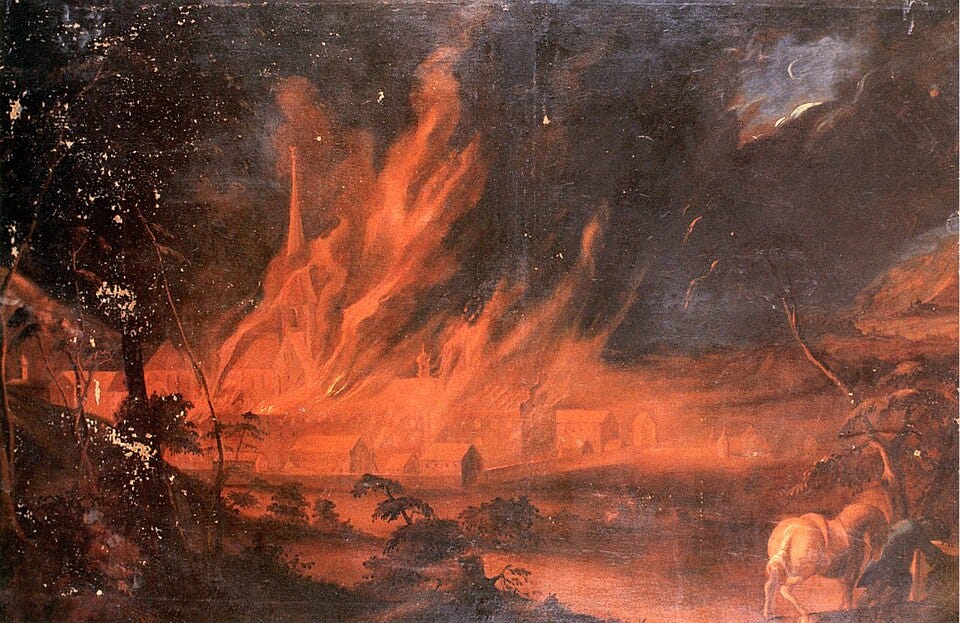
This is, of course, a very ancient way of talking—ancient and long out of style even among Christians. Yet while I am well aware of the anachronism, I am also not just being ironic or even intentionally provocative. Ancient humans detected something in the kind of foreboding darkness that I felt looking at the awful sun. They had the same feeling when seeing that things were not right, whether with the sun, or the moon, or the stars, or the earth beneath them, or the sea around them. They had the same creeping, uncanny fear at the base of their spine. Something is out of balance. Something in the order Great fire of Salem, March 9, 1697.of the creation has twisted to the point that it has snapped. We have done something to bring this upon us. We are not innocent in our choices. God is angry.
“God is angry.” No doubt these words have often been uttered out of mere superstition, or out of a desire to control and manipulate people. No doubt they have often been uttered far more than was truly appropriate. No doubt they have been abused. And yet, to this day they still convey something that we sometimes truly do need to recognize. They are words that capture what it means to have thrown our world into dangerous chaos by our own choices, and to have the Creator of that world call us back through harsh and even frightening warnings.
We have broken God’s commands to live in harmony with Him, with one another, and with what He has made.
Those warnings are now all around us. The fires, the scorching heat waves, the ever larger, earlier, more frequent hurricanes. It is no coincidence that all these kinds of weather are associated everywhere in the scriptures and in virtually all other ancient religious traditions with God’s wrath. These are the things that come when something is deeply wrong. People have always known this somehow. These are the things that come when God is angry, as He appears now once again to be.
For decades our modern culture has approached God’s creation as a set of resources to be extracted and consumed with no regard to the welfare of the earth, of its flora and fauna, or even of us human beings ourselves. We have broken God’s commands to live in harmony with Him, with one another, and with what He has made. We have refused to be stewards of what He has given us. Rather than recognizing that all that exists belongs to God alone we have made ourselves the owners and masters of all things around us. We have broken the covenant bond of love and the commandments that were given in order that our days may be long on the land. We are destroying God’s creation, and He Who made it is angry with us.
There are secular and materialist ways of framing all that as well, of course. Climate scientists can tell you at length about how different features of our weather and geology are interconnected and how our burning of fossil fuels and aggressive over-consumption have tipped just about every balance that can be tipped. That is a good and helpful way of talking about these matters and will be needed to help bring about workable solutions. But materialistic and scientific ways of framing our environmental problem can also read as detached and clinical. Talking about the complex math of CO2 levels across decades invites us to the kinds of dry responses to which we are well accustomed: treaties that aim to reach certain targets, policies that may help reduce carbon footprints by X percent or PM 2.5 pollutants to Y level. That sort of thing is fair enough as far as it goes. But it lacks a needed punch. It can mask the deep urgency of the problems we are facing and it inevitably mutes or silences any ability to truly grapple with the fact that we are to blame for what is happening. The spiritual, psychological, and emotional aspects of our environmental crisis are better captured by saying something much more ancient and stark: God is angry.
One thing that is sometimes lost to moderns—even Christians—is that in the ancient Christian and Jewish mind, God never pours down his wrath on his creatures with the intent of eradicating them—nor even, really, of punishing them in the most typical sense of that word. Rather, God’s anger comes as a message from a justly indignant Father who wills nothing other than the thriving of His children. The fire and smoke—coalescing nearly into brimstone—that descended upon many of us these weeks should be deeply frightening and disconcerting. It is meant to be. It is God calling us to wake up and see what is really happening. It is God calling us to repent of our evil ways. The call comes not at all because God hates us, but precisely because He loves us and would not have us live in the kind of sickened and disrupted world that we are so rapidly creating for ourselves.
For all my life until this point it has seemed clear that the message the world most needs to hear from the Church is that God loves us—every one of us—beyond anything we can possibly imagine. The problems surrounding me in the roughly four decades that I have been alive have all seemed to need that response. People are hurting, desperate, addicted, fighting in wars, abusing one another. The Gospel message of God’s absolute love is the antidote for these things. If only we could preach it more forcefully and with more conviction.
And yet I have long noticed that at other times in human history Christians of deep faith—Christians who insist that the Creator is a loving God—have concluded that what the world around them needs to hear is that God is furious with us all. In many cases perhaps they were just ignorant or backwards—trying to scare people into some kind of submission or gain power for themselves. In some cases they were probably simply lying or stupid. But in at least a few cases, I think perhaps preachers past were earnestly responding to a different kind of world: one in which the images and symbols of God’s anger were needed to communicate deep moral and theological truths. Indeed, Jesus Himself uses such imagery repeatedly in his teaching. He preaches love above all things, but also dire consequences for those who do not repent. While many vices in the Lord’s world apparently needed to be met with forgiveness and compassion, many others (it seems) were best met with a reminder that we all may be headed for a place of flaming fire, and of wailing and gnashing of teeth...and not just after we die. If it were not so, would the Lord have preached thus? I have begun to wonder if we are now entering an era in which such messages are needed once again—not at all to the exclusion of the much more comfortable messages of God’s absolute love, but in tandem with them. When it comes to what we are doing to the earth I think perhaps it is time that we begin to ponder and even to preach the fury of Yahweh alongside His compassion.
The time will come soon when God will call down the true, full power of his fury.
God is angry. I felt it that day looking at the horrible sun and choking on the air that was meant for me to breathe. You may have felt it that same day if you live anywhere near me. Or you may have felt it when your home was wracked by a once-in-a-millennium flood for the second time in just a few years. Or you may have felt it in the record breaking heat or the ice storm that your region is never supposed to experience. Or you may have felt it when watching a group of refugees on the news escaping someplace that their people have lived safely for thousands of years, but that is no longer safe for them because of fire, or famine, or hurricane, or earthquake. If you have not felt it yet, you will soon—because the signs and sounds are only going to get louder and louder. To this point we have taken not one single meaningful step to appease the wrath of God with regard to our destruction of His creation. And since we have not done so, that wrath will build and build until it can no longer be ignored. The time will come soon when God will call down the true, full power of his fury. And in that day even the most hardened materialist atheist with feel that same horror in their animal spine that I felt so recently when looking at the sun. All people, no matter their faith, will begin to truly see that something must be done. In that day the many Christians who can only ever picture God’s wrath brought down upon everyone else will see that they, too, are as implicated as anyone. In that day humanity will recognize that something has truly changed, and that we must therefore also change.
That is the hope of God’s anger. As a father metes out progressive discipline, so too does God. The sooner we realize what it means, the sooner we can change our ways and return to prosperity and peace. It is for our own good that we should listen now—right away while the signs are not yet nearly as violent as they may soon become. But we can rest assured that He will not let us simply ignore Him forever. If you are worried that the human race will be able to render itself extinct by way of our destruction of the planet, then you do not know God for Who He is. We will not come close. He will have either returned once and for all or, more likely, turned us back from our evil ways through the force of His wrath long before then. Yet the longer we drag our heels, the more painful the turning will have to be. The more fires we invite upon the earth, the thicker the smoke will become. It is not God who will suffer as a result.
Christian friends, what should we do?
Every generation of faith has known the first and foremost answer. We must begin by repenting. We must begin by admitting to ourselves that we have not lived in accordance with God’s will. In our case, we must realize that our avarice, our gluttony, and our desire for power have caused us to horrifically abuse God’s creation. We must every one of us change our hearts away from such a way of living.
From repentance must grow the most powerful response that we can muster. We must pray. Ours must not be the light and gentle prayer of people merely worried about some small disruption in life. It must not be the prayer of one who believes that prayer is only warranted when real action feels too difficult or has not worked. No, ours must be the prayer of a terrified child calling out with a sense of both absolute desperation and absolute hope—crying to the heavens in the knowledge that they do and will hear us even though nothing else seems to. Ours must be the prayer that moves mountains, heals lepers, grants forgiveness to sinners. Ours must be the prayer of miracle workers. We must pray hard for ourselves, for everyone around us, for our leaders, for the creation that we love. We must pray for God’s intervention. And we must know that it does something to pray this way. A world of 8 billion people with eyes turned to heaven asking God to forgive and to unbreak the creation that we have broken will in a mere instant receive exactly that for which it asks. Even a secularist can see that this would change everything however much they may deny God’s hand in the matter. All the more must we as people of faith see it.
And then, out from our prayer—which is the primary action that truly reshapes the cosmos—must flow work and cooperation. We must do two things at once, both of which could and would transpire almost overnight if we were to work together to achieve them. First, we must cease wasting. We must stop consuming for frivolous reasons—and often for no reason at all. It is not that we all must begin to live as austere monks and nuns with just one garment and only a biscuit each day for food. Rather, we must be content with enough—have a purpose for what we own and consume even if that purpose is to enjoy our leisure time. At present we are driven by gluttony, avarice, lust, and the desire for power to consume far far beyond the point that our possessions have made us maximally happy and comfortable. We keep consuming beyond that point so much that we often become unhappy because of our very accumulation—and still we keep going, ripping apart the earth though we no longer even take pleasure in the result to say nothing about meeting our actual needs. God hates such unabashed vice, and upon it He will bring down His wrath. We must reduce the burden of pure and absolute waste on the creation and align ourselves with God’s desire for how we should live. This will do a great deal to turn back God’s wrath and to restore order to the climate over time. Yet it will not do everything, or even close to enough.
Not one single person on the planet today is even close to living a “sustainable life” on their own.
And so, second, we must come together and build the technology and infrastructure we need so that a reasonable life can also be a sustainable one. Our rampant and pointless consumption is horrifyingly vicious, but much of the problem with our relationship to creation is not about waste or even vice. There is no sin in the human desire to connect with one another, to explore, to communicate, to invent, to create, to pray and worship together, and to grow and thrive as a species. But in our modern world even all these good things do damage.
To visit my father, my mother, my sister, my brothers, and many old friends I must drive or fly somewhere (or else they must come to me the same way). To learn anything at all I must attend a class or at least turn on a computer that uses electricity or open a book that has been sent from somewhere to somewhere else. To have a life that ever feels worth living I must connect with art and beauty that requires me to get to a theatre or museum or local concert venue wherein lights must be on and sound must be relayed. To pray with my community and receive the Body of Christ I must make my way to church on Sunday where we need to have at least a bit of heat in the winter if nothing else. All of that would fine enough—wonderful in fact—but under current circumstances our ways of doing any of these things require the destruction of the earth even when we try to mitigate the effects. Because of our supply chain, I cannot feed my family without loads of plastic and fossil fuels even if I want to. I cannot get to church without burning something even if I take the bus. I cannot fly out to visit an old friend in a hard time without dumping carbon into the air; meeting up on Zoom instead is hardly the same and even that takes a good dose of energy. None of these things is wasteful—these are good things that we should all continue to do. But the system in which we all live nonetheless makes them damaging to the creation. That must change and change very quickly.
If we are going to ask ourselves to cease wasting and over-consuming (and we should), we must also give ourselves hope that we can actively do something about the mess we are in. We need to remind ourselves that we can find the technologies and strategies that allow humans to truly thrive without needing to set the earth on fire in the process. We must abandon the politics of constant shame and derision; wagging our fingers at choices we don’t like and calling each other names has done nothing to avert God’s growing rage or to save the planet. We learned well during the COVID pandemic that shame tactics, austerity, and limitations alone cannot bring society together to defeat a common enemy. We traded almost the entirety of our social cohesion for a few marginal public health gains at best because the tactics of shame and limitation rely only on extracting spiritual and psychological energy from people; they give nothing back to re-energize us and bring us together again.
The greatest of previous generations took challenges like the ones we now face with our environment as opportunities to reflect their divine nature by building goodwill and trust—filling people with purpose and a sense of potential accomplishment. Previous generations came together to do hard things—to struggle to overcome. Nothing gives human beings more drive, and nothing brings us closer together than overcoming a threat or crisis together as brothers and sisters. We must emulate these generations past in their greatest moments. We must seize the chance to do something both difficult and glorious by setting aside whatever is distracting us and creating what needs to be created to stop the destruction of the planet without expecting humans to stop being human. There is no other priority for humanity as a whole. There is no other secular political agenda that even remotely matters by comparison. Our leaders need to begin to share a message of hope, and provide positive targets for which we can strive in order to return to the kind of blessed and peaceful world in which God would have us and our grandchildren live.
God is angry...and that is the best news we could receive for ourselves and our children. We can do something about it. We can repent as so many generations before us have done. We can pray to the God who by choice and mysteriously works through our souls when we give them back to Him. We can let go of genuine waste by realizing that it is giving us nothing and we are happier without it. We can drop everything else that we think we are doing as a society to build and invent what we will need to return the creation to health.
We can come together to turn the tide by His Strength and Grace. Let us do so now. Hope is never diminished. God loves us.
And as it so often is, it’s the rich and powerful who do the most polluting, and the poor and helpless who suffer the greatest consequences. Easier it is for a camel to pass through the eye of a needle…